
Custom CNC Machining Solutions
Custom CNC Machined Double Flange Hub Components
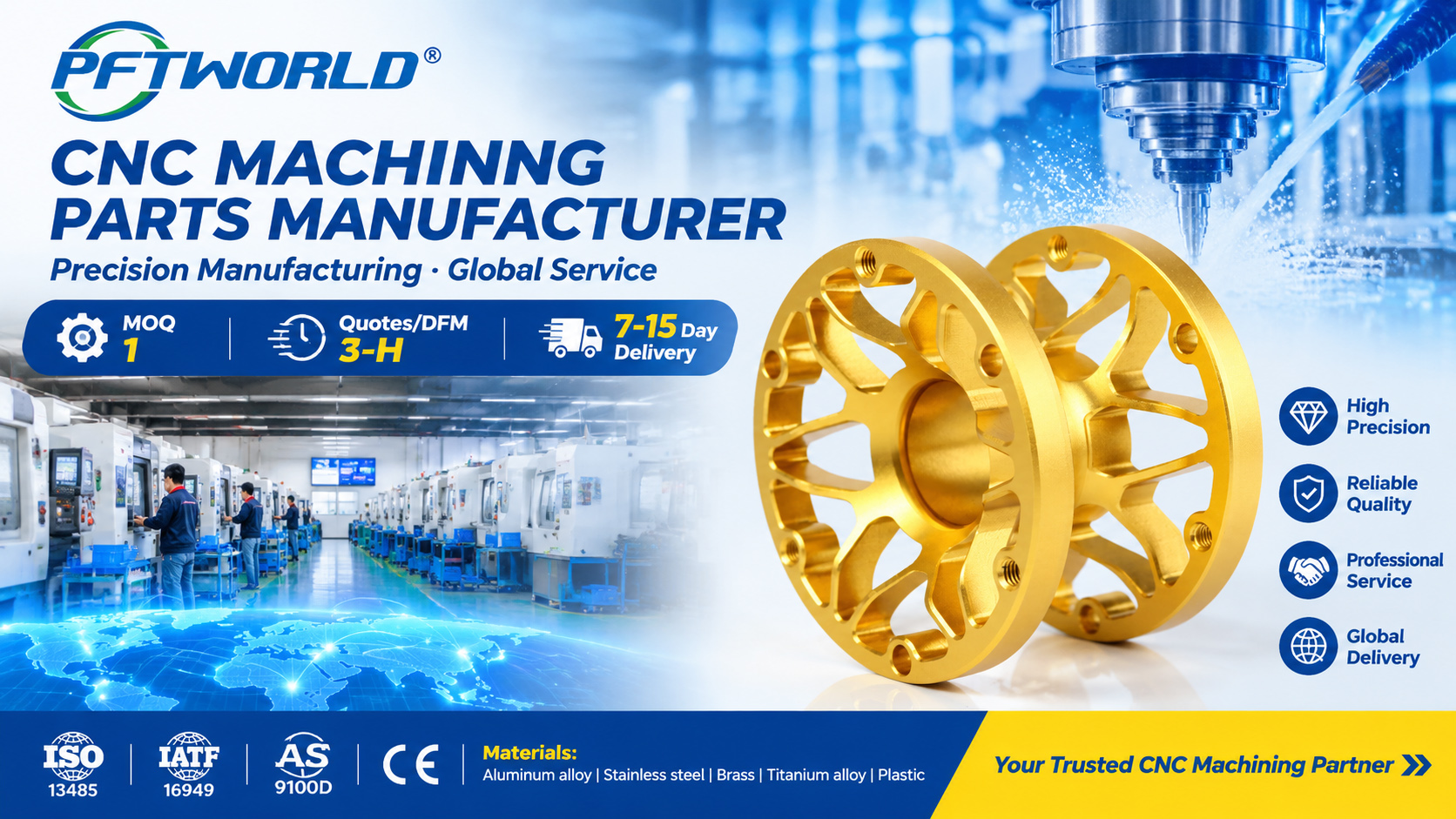
Precision-manufactured double flange hubs with circular mounting features, a central cylindrical hub and a shaped center opening. PFTWORLD supports drawing-based OEM machining for custom mechanical components, from prototype evaluation to production planning.
Custom Double Flange Hub Manufacturing
A double flange hub is a mechanical component that combines circular mounting surfaces with a central connecting or locating structure. Its geometry can include two flange plates, multiple circumferential mounting holes, a stepped cylindrical hub and a shaped opening at the center. These features may work together to support positioning, mounting, connection or torque transmission within a larger mechanical assembly. The actual function depends on the mating components and the approved engineering drawing.
The component shown in this product category has a distinctive two-flange configuration and a dark finished appearance. Its visible geometry makes it a suitable example of a custom CNC machined flange hub. However, material grade, hole dimensions, dimensional tolerances, surface-treatment specification and mechanical performance must be established from the customer’s technical documentation rather than estimated from appearance alone.
Shenzhen Perfect Precision Products Co., Ltd. provides custom OEM and ODM manufacturing services for industrial mechanical components. PFTWORLD can review customer drawings, 3D models or physical samples to evaluate the required machining operations, material selection, critical dimensions, finishing requirements and production quantity. Each quotation should be based on the actual part specification.
Key Design Features of CNC Machined Flange Hubs
1. Dual Circular Flange Structure
The two flange sections provide circular mounting surfaces that can be designed to connect with other mechanical components. Their outside diameters, thicknesses, spacing and surface relationships should be defined according to the assembly requirements. For components that must sit against mating faces, flatness and perpendicularity may be important inspection characteristics.
2. Circumferential Mounting Holes
The mounting holes are distributed around the flange surfaces. Their positions may be defined using a bolt-circle diameter, hole count, angular spacing and positional tolerances. These details are essential when the component must align with a mating plate, housing or fastening arrangement. Hole diameter, thread requirements, countersinks and counterbores should be clearly specified on the engineering drawing.
3. Central Cylindrical Hub
The raised central hub creates a stepped cylindrical geometry between the flange surfaces and the central opening. Depending on the assembly, the hub may provide a locating interface, clearance, support or a connection point. Its outside diameter, length, shoulder dimensions and relationship to the flange axis should be evaluated as functional characteristics.
4. Shaped Center Opening
The visible center opening has a square-shaped appearance. Such a feature may be intended for a mating drive element, locating feature or mechanical connection, but its actual purpose cannot be confirmed from a product photograph. The drawing should specify its width, depth, corner geometry, orientation, fit and applicable tolerances. If the opening is used for torque transfer, the contact geometry and load requirements also need engineering review.
CNC Machining Processes for Double Flange Components
Double flange hubs combine rotational geometry with non-rotational features. Selecting an appropriate machining route requires consideration of the material, part dimensions, production quantity, tolerance requirements, surface quality and tool accessibility. PFTWORLD reviews these factors before recommending a manufacturing process.
CNC Turning for Cylindrical Features
CNC turning is suitable for rotational surfaces such as hub diameters, flange profiles, shoulders, circular grooves and stepped cylindrical features. A properly planned turning operation can establish important reference surfaces for subsequent machining. Where the central axis and flange faces are functionally related, the machining sequence and workholding method should be planned to control their relationship.
CNC Milling for Mounting Features
CNC milling can produce mounting holes, slots, flats, pockets and other features that are not rotationally symmetric. For a flange with multiple mounting holes, the programmed coordinate system and workholding arrangement should be selected according to the drawing datum structure. This helps the manufacturer evaluate the position of each hole relative to the specified functional references.
Combined Turning and Milling
Some double flange designs require both turning and milling operations. A combined process may be appropriate when cylindrical surfaces, stepped shoulders and mounting features must be produced on the same component. Depending on the part geometry and available equipment, mill-turn machining or carefully controlled multi-operation machining may be considered. The final route should be selected after reviewing setup requirements, feature access, production volume and cost.
Material Selection for Custom CNC Flange Hubs
Material selection affects machinability, strength, weight, corrosion resistance, finishing compatibility and overall production cost. The correct material should be selected according to the component’s operating environment and functional requirements.
Aluminum alloys are commonly considered when low weight, machinability and a suitable surface finish are important. Stainless steel may be considered where corrosion resistance and mechanical strength are priorities. Carbon and alloy steels can be evaluated for applications requiring specific mechanical properties. Brass, copper and engineering plastics may also be suitable for certain component designs.
Aluminum 6061-T6 is one possible material for custom machined components, but the exact alloy and temper for this particular flange hub have not been verified. Customers should state the required material grade and condition on the drawing or RFQ. Material certificates and traceability documents can be discussed when required by the project.
Black Surface Finishing for CNC Machined Components
A black finish can provide a consistent appearance and may contribute to the required surface protection, depending on the selected finishing process. The correct treatment must be identified before production because different processes have different material compatibility, coating characteristics and dimensional effects.
For aluminum components, black anodizing may be considered when the design requires an anodic surface layer and a specified color. The drawing or purchase specification should define the anodizing type, coating thickness, color acceptance, sealing requirements and any masking areas. Coating buildup can affect functional dimensions, particularly internal holes, bores and mating diameters.
Other possible finishing options include black oxide for suitable ferrous materials, powder coating, polishing, plating and other specified treatments. These options are not interchangeable. PFTWORLD can review the requested finish and coordinate the appropriate manufacturing requirements according to the material and project specification.
For components with precision mounting holes or fitted center openings, buyers should identify whether the critical dimensions apply before or after finishing. This helps the machining and finishing teams plan allowances, masking and final inspection requirements.
Dimensional Accuracy and Quality Inspection
Reliable flange assembly depends on controlling the dimensions and geometric relationships that affect fit and alignment. The most important characteristics should be identified on the drawing instead of assigning unnecessarily tight tolerances to every feature.
Depending on the design, inspection may cover flange outside diameters, plate thickness, hub diameter, hub length, central opening dimensions, mounting-hole diameters and bolt-circle positions. Geometric requirements may include flatness, perpendicularity, position and runout where these characteristics are functionally necessary.
PFTWORLD’s published manufacturing information describes general machining capability of ±0.01 mm, with special areas subject to review at ±0.005 mm. These are general capability statements, not guaranteed results for every dimension of this component. Achievable tolerances depend on material, geometry, feature size, workholding, machining route and the agreed measurement method.
The company’s documented inspection resources include CMM and 2D measuring instruments. Its described quality workflow includes incoming material inspection, first article inspection, in-process checks and pre-shipment inspection. Buyers requiring dimensional reports, first article documentation, certificates of conformity or material certificates should identify those requirements during quotation.
Custom Manufacturing for OEM Applications
Custom double flange hubs may be used in mechanical assemblies where circular mounting interfaces, central locating features or shaped openings are required. Potential application areas should be determined from the actual engineering design. Similar component geometries may be found in industrial machinery, automation equipment, mechanical fixtures, power transmission assemblies and customized equipment structures.
These examples describe potential application categories rather than confirmed end uses of the pictured part. The final suitability of a component depends on its material, dimensions, loading conditions, mating interfaces, operating environment and validation requirements.
For OEM buyers, drawing-based manufacturing helps align the design intent with the production and inspection plan. PFTWORLD supports custom machining projects that may involve prototype evaluation, small-batch production and repeat manufacturing. Quantity, lead time, material availability and process feasibility are confirmed during the quotation review.
Why Work with PFTWORLD?
PFTWORLD, operated by Shenzhen Perfect Precision Products Co., Ltd., provides custom manufacturing services for customers requiring precision mechanical components. The company’s published capabilities include CNC milling, CNC turning, multi-axis machining and combined manufacturing processes, together with additional manufacturing services for different project requirements.
Its manufacturing information identifies a multi-process production model, supported by engineering review and quality inspection resources. This enables the team to assess components with different machining features and review how material, tolerances, finishing and quantity influence the production plan.
For a custom flange hub project, buyers can discuss the drawing revision, functional dimensions, central opening, mounting pattern, surface treatment and inspection requirements before committing to a production specification. This drawing-based approach helps reduce ambiguity during quotation and provides a clearer basis for manufacturing communication.
What to Include in Your CNC Machining RFQ
Providing complete technical information helps the manufacturer evaluate the part more accurately. Whenever possible, include a 2D engineering drawing and a corresponding 3D CAD model. The following information is particularly useful for double flange hub components:
- Material grade, temper and heat-treatment requirements.
- Overall dimensions, flange thickness and hub geometry.
- Mounting-hole quantity, diameter, bolt-circle dimensions and positional tolerances.
- Central opening dimensions, shape, orientation and depth.
- Functional datums and critical geometric tolerances.
- Surface roughness, deburring and edge-condition requirements.
- Surface-treatment type, color, coating thickness and masking areas.
- Prototype quantity, production quantity and expected annual demand.
- Inspection reports, material certificates and packaging requirements.
- Target delivery date and shipping destination.
Common engineering file formats listed in the company’s product information include PDF, STEP, IGES, STL, DWG and DXF. If only a physical sample or product photograph is available, contact the engineering team to discuss whether additional measurements or drawing development are needed before quotation.
Frequently Asked Questions
Can PFTWORLD manufacture double flange hubs according to customer drawings?
Yes. PFTWORLD provides drawing-based custom manufacturing services. Submit your 2D drawing, 3D model or sample information so the engineering team can review the geometry, material, tolerances and production requirements.
What materials are available for CNC machined flange components?
Material options listed in the company’s manufacturing information include aluminum, stainless steel, carbon and alloy steel, brass, copper, titanium and engineering plastics. The final material should be selected according to the drawing and application requirements.
Can you machine mounting holes and shaped center openings?
Hole patterns, slots, flats and shaped openings can be evaluated as part of a custom CNC machining project. Their feasibility and tolerances depend on the geometry, material, machine access and required inspection method.
Can the component receive a black finish?
Black anodizing and other finishing options can be discussed according to the substrate material and customer specification. The exact process, coating thickness, color and masking requirements should be confirmed before production.
What machining tolerance can be achieved?
The company’s published general capability is ±0.01 mm, with special areas subject to review at ±0.005 mm. Actual achievable tolerances must be evaluated against the specific drawing, material, feature geometry and inspection plan.
Can I order prototypes or small quantities?
PFTWORLD’s published service information describes prototype and low-volume custom machining support. Minimum order quantities, sample arrangements, setup requirements and production schedules should be confirmed for each design.
What information is needed to receive a quotation?
Provide the drawing or 3D model, material, critical tolerances, surface finish, required quantity and target delivery schedule. Additional inspection or documentation requirements should also be included.
Request a Custom CNC Flange Hub Quote
Looking for a manufacturing partner for custom double flange hubs or other precision mechanical components? Send PFTWORLD your drawings, CAD files or sample details. Our team can review the machining route, material, critical dimensions, finishing requirements and inspection scope for your project.
Product note: Visible geometry is described from the supplied product photograph. Material grade, exact dimensions, functional application, tolerances, surface-treatment process and inspection results must be confirmed through the approved engineering drawing and written quotation. General manufacturing capabilities do not constitute guaranteed specifications for an individual component.
Post time: Nov-05-2026


